
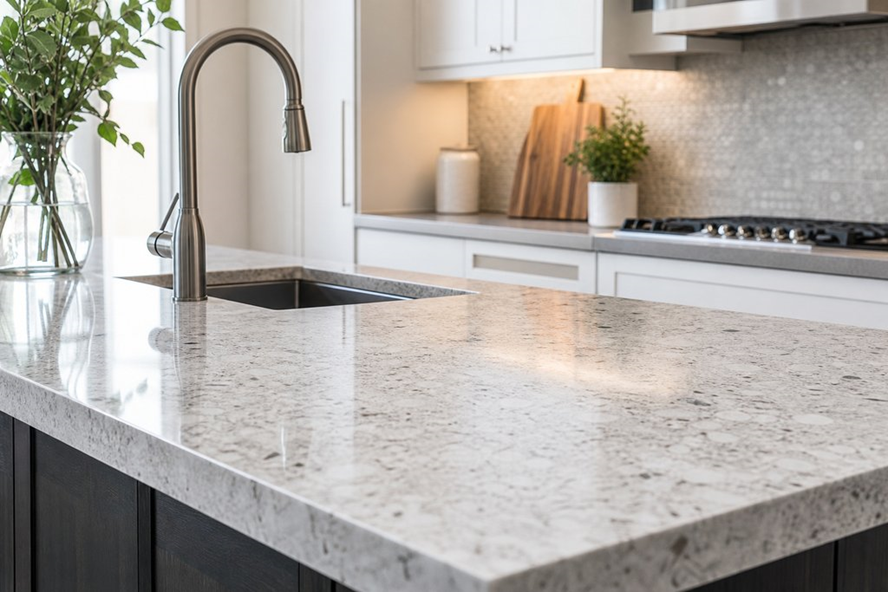
Kitchen countertops and cabinetry
Kitchen countertop costs vary widely based on material, square footage, edge profile, backsplash requirements, sink type, and other variables. The final price also depends on your specific needs.
Match the Countertop to Your Daily Routine
Choosing a countertop is never easy. The best option will depend on the way you use your kitchen, the condition of your cabinets, your budget, your sense of style, your tolerance for upkeep, and several other variables. The right counter also impacts how you’ll design and use the space, influencing:
- Storage planning
- The look, feel, and function of the room
- The best layout, traffic patterns, and appliance placement
- Lighting design
- The style of cabinets and flooring you’ll want
Once you’ve considered your priorities for the project, take time to view samples in person. Visually narrow down a handful of materials, colors, and patterns, and review full slabs if possible. Colors and patterns can be deceptive in small samples. Viewing them in person also lets you see how they look in indoor and natural light. A busy pattern that looks subtle in a small piece of granite or quartz may overwhelm a large island.
Compare Materials by Performance and Upkeep
Each type of countertop has its own personality. Reviewing their strengths and limitations in person will help you find the best fit. Ask the contractor to show you examples of each material. Discuss:
- The level of maintenance and care each type of countertop requires
- How well they hold up to scratches and heat
- Your interest in an undermount sink
- How often you cook and whether you prepare much of your food on the counter
- Whether you use knives on the counter frequently
- Whether you’ll be moving hot pots and pans directly onto the counter
- How well each option fits your sense of style, existing decor, and renovation goals
- Whether you plan to sell the home anytime soon
Quartz Delivers Consistent Style With Less Upkeep
A nonporous engineered surface made from ground-up natural stone and resin, quartz comes in a wide range of shades and patterns. The material can emulate natural stone, feature a uniform hue that suits contemporary spaces, and more. Since it requires little upkeep and doesn’t have to be resealed on a regular basis, quartz is a low-maintenance countertop option – Wikipedia has a clear page on this at en.wikipedia.org/wiki/Engineered_stone. Keep in mind that hot pots and pans can damage the resin in quartz.
Granite Brings Natural Variation to Every Slab
Known for its durability and classic beauty, granite offers rich hues and patterns. Each slab is one-of-a-kind and showcases mineral deposits, fissures, and other characteristics that provide depth and movement. Ask your countertop contractor to educate you on what to expect from granite so that you don’t mistake these traits for imperfections. Depending on the granite, some may require sealing at various intervals.
Marble and Other Natural Stones Require More Care
Soft and delicate, marble is an opulent countertop material that’s perfect for transitional, traditional, and coastal-inspired kitchens. Acidic substances can stain it and scratching is inevitable. Many people embrace its lived-in patina that develops with use. Other types of natural stone offer their own benefits, patterns, colors, and personalities. Discuss the options with your countertop contractor.
Measure Cabinets, Walls, and Overhangs Precisely
Countertop materials and installation details
Renovated and older homes are notorious for having walls that aren’t perfectly square, especially here in Davie and other communities in Broward County. For a local reference, countertop contractor near Nova Southeastern University is the page that matches this area; skip this if you are only comparing materials. The contractor should take into account the following variables:
- Whether cabinets need to be leveled
- How they’re anchored to the wall
- If your design includes an island, especially if it’s large enough to need reinforcement
- Whether cabinets can support the weight of natural stone
- If they have adequate support
- Whether you’re changing your sink
- If you’re switching to an undermount sink
- How you’ll be using your counter
- Where seams will fall based on the design and slab size, how they’ll be secured, and how the counters will be maneuvered into your home
Confirm the Estimate Before Fabrication Begins
Check What the Countertop Estimate Includes
To compare estimates from different countertop contractors, request a breakdown of pricing and what’s included. Your estimate should identify:
- Demolition and removal of existing counters
- Cost of countertop material by square foot, including the brand and color
- The number of slabs needed
- Delivery and installation
- Sink cut-outs and sink installation (if applicable)
- Any special installation needs, such as brackets
- Backsplash costs, material, size, and who’ll handle tiling it
- Seam placement
- Sink and faucet costs, including who’ll reconnect your sink
- Edge profile
- Material thickness
- Surface finish
Keep in mind that an estimate can change after the contractor comes out to template the counters and obtains exact measurements. This is particularly true if you have an unusually large kitchen island, a waterfall countertop that wraps around the front of your island, a full-height backsplash, and other unique characteristics.
Prepare the Space for Installation
Once the cabinets are ready and the countertops are templated, they’re taken back to the shop to be fabricated according to your selections and specifications. Once they’re ready to be delivered and installed, make sure that the path into the home is clear of breakable objects, furniture, etc. Pets should be contained and kept away from the work area for their own safety.
During installation, the crew may shim the counters as needed to compensate for walls that aren’t plumb or square. Seams are secured, sinks are installed, dishwashers are reconnected, etc. Once the countertops are in place, your backsplash will be tiled, sinks will be plumbed, and the job will be complete.
Before the countertops are fabricated, you’ll make final decisions about the following:
- Sink models, faucet location, etc.
- The location of seams
- The depth of the countertop overhang
- The style of the edge profile
Bring the faucet and sink specifications to your templating appointment. If your job includes a backsplash, discuss how it will be incorporated into the schedule. If you’re unsure about any of these decisions, ask for advice. The more you understand about the countertop installation process, the better equipped you’ll be to make informed decisions about your project.
